Disclaimer:
I am not a medical professional, and the information shared in this post reflects my personal experiences and observations with sleep tracking. This content is for educational and informational purposes only and should not be taken as medical advice. If you have concerns about your sleep, health, or medical condition, please consult a qualified healthcare provider.
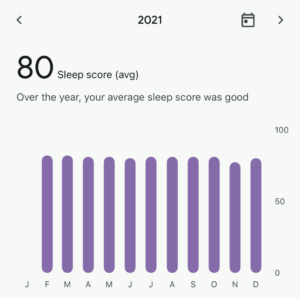
Sleep Score Avg 2021
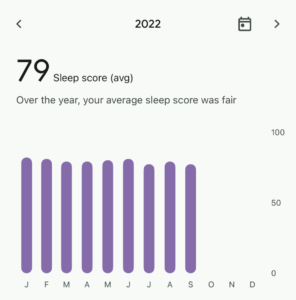
Sleep Score Avg 2022
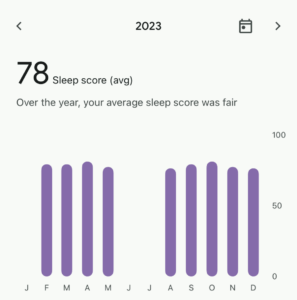
Sleep Score Avg 2023
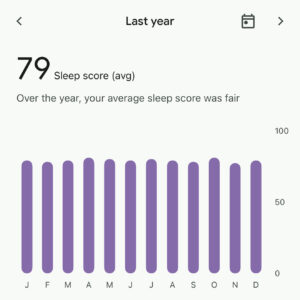
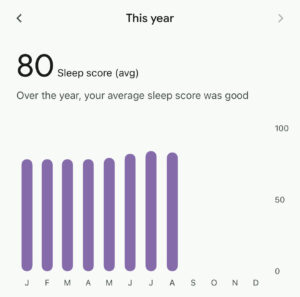
Sleep Score Avg 2024
Sleep Score Avg 2025
If there’s one area of health and fitness I’ve struggled with the most, it’s sleep. While I’ve built consistency with training and nutrition, I’ve come to realize that sleep is my biggest weakness. Tracking my rest over the past several years has made this very clear — and it’s also shown me the progress I’m starting to make.
What Sleep Is and Why It Matters
Sleep isn’t just downtime — it’s an active process where your body and brain work to restore balance. During quality sleep, your muscles recover, your brain organizes memories, and your hormones regulate energy, stress, and appetite.
Getting enough good sleep improves focus, mood, workout recovery, and immune strength. On the other hand, poor or inconsistent sleep can lead to low energy, slower progress in fitness, and higher risks for long-term health issues like stress, weight gain, and heart disease.
In short: sleep is the foundation that makes nutrition, exercise, and recovery work together. Without it, everything else becomes harder.
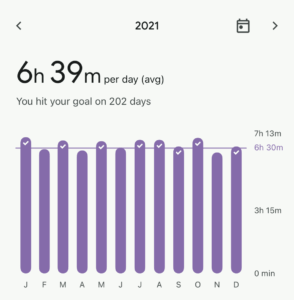
Back in 2021, I was averaging 6 hours and 39 minutes of sleep per night and hit my sleep goal on 202 days. My average score fell in the high 70s to low 80s, which put me in the “Fair to Good” range. It wasn’t perfect, but it was consistent enough to support my workouts and weight loss goals.
2022–2023: Struggling with Consistency
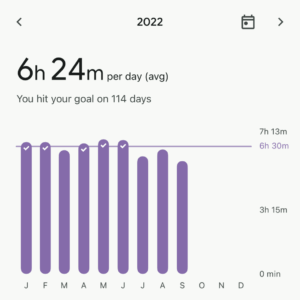
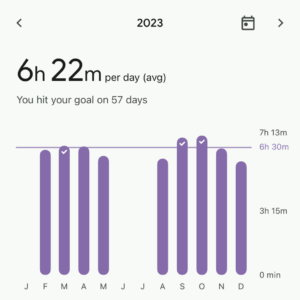
Things started to slip in 2022. My average dropped to 6 hours and 24 minutes per night, and I only hit my goal on 114 days. By 2023, sleep had clearly become my weak point. My average fell to 6 hours and 22 minutes, but the real issue was consistency — I hit my goal just 57 times all year. My sleep scores reflected this, stuck in the “Fair” range, often in the mid-to-high 70s. December 2023 hit especially hard, with just 5 hours and 43 minutes per night on average — one of my worst months on record.
2024: Fighting Back
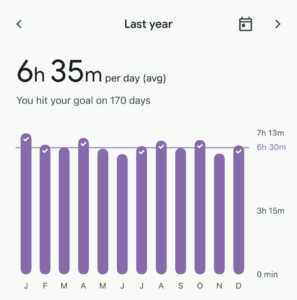
After recognizing how much poor sleep was holding me back, I made a stronger effort in 2024. My average improved to 6 hours and 35 minutes per night, and I managed to hit my sleep goal on 170 days. While my overall score stayed at 79 (“Fair”), the increase in consistency made a noticeable difference in how I felt day to day.
2025: Signs of Real Improvement
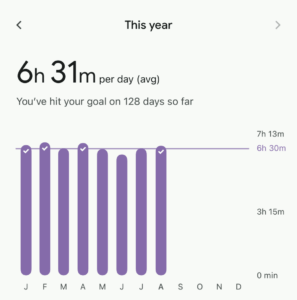
This year, 2025, is where I’ve finally started to see progress. So far, I’m averaging 6 hours and 31 minutes per night with 128 goal hits, but more importantly, my monthly scores are improving. July came in at 84, and August at 82 — both in the “Good” range. For the first time in years, my sleep quality is trending upward, not just my hours.
Why Sleep Is My Weakest Link
Looking at these numbers across several years, it’s clear that sleep is my biggest weakness. Training, nutrition, and even recovery habits outside of sleep are things I’ve managed to stay on top of, but sleep has been the one area I haven’t mastered. Even when my averages look steady, the quality and consistency haven’t been where they should be.